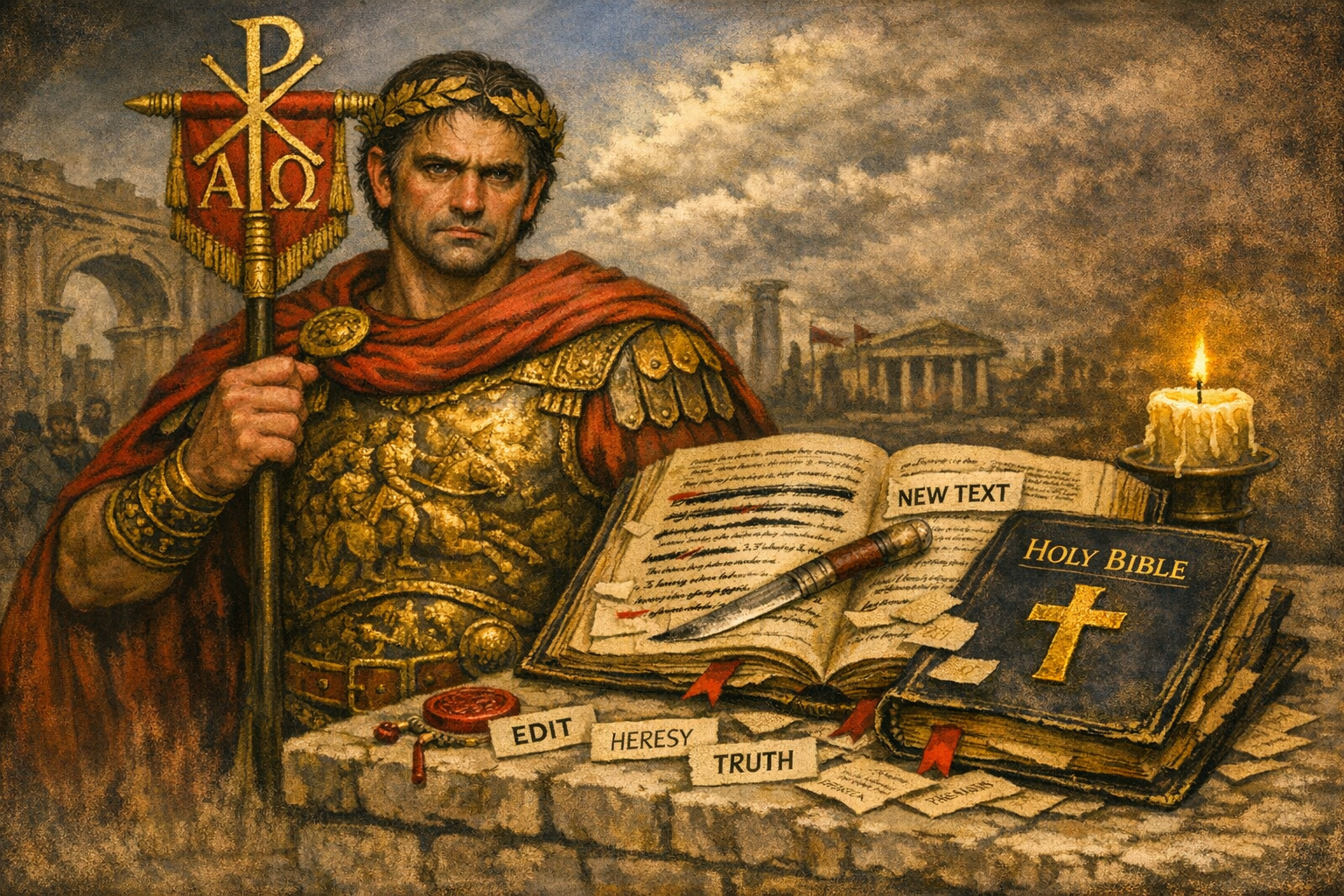
Constantine the Great was an interesting figure in Christin history, one whose influence took Christianity from being a persecuted underground church to setting it up to become the state religion. There are many different controversies that surround his influence on the church. In this post I am going to look at those accusations that involve the Bible, that it was corrupted either during his reign or by his request.
Who was Constantine the Great?
Constantine was the Emperor of Rome from 306-337 AD and was a pagan who worshipped the sun God. That is, until allegedly seeing a vision before a battle, after which he professed Christ, although some suggest he didn’t fully embrace Christianity, but rather just worshiped Jesus as the sun god.
Before Constantine, Christianity was illegal, and the church was heavily persecuted. But Constantine legalised Christianity and even became its patron. It would have seemed that he was the answer to many prayers, I’m sure. But a major problem arose in 312 AD, where Constantine was asked to settle a dispute about church practice, thereby giving the emperor authority over the church. It was this overstep that is at the center of all the controversies, Constantine seems to have had the power to not only influence the church, but potentially also the Bible. But did he?
What are the Accusations?
As I looked around at the controversies, I found many different accusations that seemed to be tailored to the goal of the accuser, for instance, the Muslim accusation is that the corruption was the adding of the deity of Christ, but the King James Only accusation is that it minimises the deity of Christ (work that one out), and that is different again to the disproving the bible crowd. But all the controversies seem to fall into the following 2 accusations…
- Constantine had an influence in the book selection at the Council of Nicea, and did so for political gain, or
- The text of the Bible was changed when Constantine ordered 50 Bibles for the churches in Constantinople.
What I was not able to find in any of the resources where I found the accusations, was evidence. Some resources seemed authoritative and definitive, but gave no references, so there was no evidence for me to follow up on.
So, after all my searching all I found is what seems to be baseless accusations. However I will answer these accusations anyway.
Just a note, that most of the evidence presented here comes from either myself trying to do the accusers job for them and find evidence to back up their story, or from resources that disprove the accusations.
Were the books of the Bible decided at the Council of Nicea?
In 325 AD Constantine called together all 1800 bishops from within the Roman Christian world to a council in Nicea. About 318 turned up.
The council was called to resolve disagreements brought about by the Arian controversy. The Arian’s say that Christ is not truly divine, but rather is a created being, similar to the Jehovah Witnesses. The council overwhelmingly decided against the Arian doctrine, calling it a heresy. The outcome of the council was the Nicene Creed, which is an extended version of the Apostle’s Creed that addresses the Arian heresy.
Evidence
There appears to be a lot of writing about what happened at the Council of Nicea, and none of those writings suggest that it dealt with deciding which books were divinely inspired (Canon).
There are however, two later writings that mention the Council of Nicea choosing Canon, they are…
Synodicon Vetus [circa 887–920]
The first bit of evidence is an anonymous, pseudo-historical book of early Christianity written between 887 and 920 AD called Synodicon Vetus, which said…
“in the house of God the books were placed down by the holy altar; then the council asked the Lord in prayer that the inspired works be found on top and–as in fact happened–the spurious on the bottom.”1
Although some might like the idea of the books of the Bible being decided through miraculous means, the historical accounts in the Synodicon Vetus are not seen by scholars to be very accurate.
A good argument I read was that, surely such a miraculous selection as that would have been mentioned by some of those that wrote about the council. But even if true, it states, by its nature, that Constantine had no hand in the selection.
Jerome’s Prologue to Judith [circa 407]
The second bit of evidence is in Jerome’s Prologue to Judith written about 407 AD where he says…
“this book [Judith] is found by the Nicene Council to have been counted among the number of the Sacred Scriptures”2
Judith was a book in the Septuagint, which was largely accepted by the early Church as being Old Testament Canon.
Jerome’s place in Church history was to translate the Bible to Latin. In doing so Jerome made comments about what books were considered to be divinely inspired. It is highly likely that this quote simply refers to that fact that, at the council, it was considered Canon, i.e. they might have quoted from it.
What Jerome meant by that quote, I guess we’ll never fully know, however the argument at hand is about the New Testament books, not the Old Testament, of which Jerome doesn’t mention at all.
An argument from silence
Just because something wasn’t said, it doesn’t mean that it didn’t happen. However, when there is evidence that it happened sometime later, silence on the matter can be a valid argument. That is what we have here.
Athanasius, a 4th-century bishop of Alexandria, in his famous Festal Letter dated 367 AD, mentions all 27 books of the New Testament in an attempt to end disputes about which books were authoritative (so disputes still existed)3. Athanasius did attend the council of Nicea as a Deacon, but he had no love for Constantine. In fact he was exiled by Constantine for not following his orders. Yet he mentions nothing about Constantine influencing book selection at Nicea.
The 27 books of the New Testament were formally canonized during the councils of Hippo (393 AD) and Carthage (397 AD)
in North Africa. Before that, there were still disagreements. If there were still disagreements after the council of Nicea, disagreements that lead to the councils of Hippo and Carthage, then surely this shows that there was no decision made about the books at Nicea, and that silence on the matter is actually evidence of that fact.
Conclusion
The only real bit of evidence about Canon being decided at the council of Nicea is a somewhat dubious pseudo-historical book written at least 562 years later. Compare that to the fact that it wasn’t recorded as happening, that there was still disagreement afterward, and the evidence that it was decided upon at the councils of Hippo and Carthage, and there really cannot be any argument, it simply didn’t happen.
However, for arguments sake, even if they are correct (which they are not), and Canon was decided there (which it wasn’t), it still doesn’t, at all, show that Constantine had any influence over the decision, but rather, quite the opposite, it only shows that they were divinely chosen.
We can only conclude that Constantine had no hand in deciding what books were considered Canon.
Corruption of the text
At around 331 AD, Constantine commissioned 50 bibles to be created and distributed to the churches in Constantinople. Eusebius (the historian) was the one commissioned to produce those bibles.
There are two accusations here,
- The first accusation is that Constantine requested that the text be altered, and Eusebius complied.
- The second goes like this, Eusebius was a pupil of Pamphilus, who was a pupil of Origen. Origin was a theologian and the founder of the Christian School of Caesarea, he also had a very large library of sacred texts, but he was also known to have beliefs that differed from standard Christian beliefs, so much so, that he was formally condemned as a heretic in 553 AD (290 years after his death). The accusation is that Eusebius used Origins library and that either Origin or Eusebius altered the texts in that library to be more inline with their beliefs.
The accusations go a step further to say that those Bibles that Eusebius created were used as a base for the Bibles we use today. Although the King James Only accusation suggests that their Bible was immune to the corruption (comes from pure manuscripts).
Evidence
In Eusebius’s own words
In Eusebius’s book ‘Life of Constantine’, Book IV, Chapter 36, Eusebius records the contents of Constantine’s letter where he requested the 50 Bibles, and in the next chapter (37), Eusebius writes that he did as requested4.
Regarding his link to Origen, and access to Origen’s library, we see bits of it all over Eusebius’s writings, but a good summary of it can be found in Wikipedia.
So what we see here is that Eusebius likely did in fact hold to Origen’s beliefs, and did have access to Origen’s library, and it does seem likely that those texts would have been used for the 50 Bibles. But what is missing from all this is evidence of the text of the scriptures being altered. It is a huge leap from being a protector of the sacred scriptures to altering them, and we have no evidence that they were altered, we do however have evidence that they were not altered, lets take a look at that.
Comparison of the manuscripts
There are two different ancient Bibles that were written around that time, Codex Vaticanus and Codex Sinaiticus. Both dated around the mid of the 4th Century. Some scholars believe that one of those might have been one of the 50, but nobody really knows for sure. That might be a clue in itself, shouldn’t it be obvious from the corruption?
What we do know however, is that there is a bunch of manuscripts that date before the Council of Nicea, and even before Constantine was emperor.
Here is a classified list of the most important manuscripts. P refers to papyri; B refers to Codex Vaticanus (I removed the years after 300 as they are not needed for this study)
| ca. A.D. | 200 | 250 | 300 |
| Matthew | P45 | B | |
| Mark | P45 | B | |
| Luke | P4,P45,P75 | B | |
| John | P66 | P45,P75 | B |
| Acts | P45 | B | |
| Romans->Hebrews | P46 | B | |
| James->Jude | P72,B | ||
| Apocalypse | P47 |
Source: Dating the Oldest New Testament Manuscripts by Peter van Minnen
In addition to the above, there are many partial manuscripts, or fragments, and also many quotations of the New Testament in the writings of the Church Fathers.
One thing I want to add to this is that P66, one of the earliest manuscripts, which reaffirms what we read in our Bible in John 1, that is, it confirms the deity of Christ well before Constantine.
Conclusion
With all this earlier information, such a corruption could easily be caught, but there is no evidence of that.
There is no evidence that a corruption was requested, there is no evidence that a corruption was provided, and there is no evidence that a corruption occurred.
Bring it all together
It is no surprise that a lot of controversies start with Constantine, he was both a dodgy and influential character in Christian history, if you wanted to insert an allegation, then Constantine’s reign is the best place to do it.
Regarding the selection of Canon at the Council of Nicea, there is simply no evidence. In fact Eusebius, in his Ecclesiastical History (312–324 AD), had mentioned that most of the churches were already using the 27 books prior to the Council. There was some disagreement over 5 of the books, but that seems to have persisted to after the council, strongly suggesting that the council had nothing to do with it.
Regarding the corruption of the text, again, there no evidence. There appears to be a lot of evidence of what was around, but none of it shows corruption.
According to a couple of sites I looked at, the source of a lot of the controversies was the Dan Brown book and movie The Da Vinci Code – a fictional story. That seems to explain a lot as there is nothing to the accusations but stories and suggestions. When it comes down to proof, the accusations are baseless.
To me that says the majority of the proof is in faith. Muslims must believe the Bible is corrupted, you cannot have both Islam and the Bible being true, one has to be false. It is exactly the same with Atheism and the Bible, only one can be true. But in all situations, it is the Bible that is proven true.
The King James Only controversy is a little different, both can be true, both are Christian, both are Bibles, just minor differences that don’t affect doctrine, which only a few worry about. But that is for another day. The main point here is that there was no evidence of corruption to back up their arguments.
There is simply no evidence.
Further Reading
- Did Constantine Decide the New Testament Canon? – by Ronald V. Huggins for Midwestern Journal of Theology 8.2/9.1
This is a great paper and is well worth a read. It seems to have the most thorough analysis of the controversy, looking to where it might have come from and answering each point. It also goes into KJV only. - Did Emperor Constantine Create the Canon? – by Paul Gibson – BibleQuestions.info
I found this article to be a worthy read - The Great Myths 4: Constantine, Nicaea and the Bible – Tim O’Neill – History For Atheists
This article is from a atheist point of view, but still comes to the same conclusion – there is no evidence.
References
- Quote taken from https://biblequestions.info/2019/09/21/did-emperor-constantine-create-the-canon/ ↩︎
- Quote taken from Fourth Century Christianity » Jerome’s Preface to the Book of Judith (c. A.D. 407) ↩︎
- An article on Athanasius’s influence over Cannon https://christianhistoryinstitute.org/magazine/article/athanasius-defines-new-testament ↩︎
- Eusebius – Life of Constantine https://www.newadvent.org/fathers/25024.htm ↩︎
Leave a Reply